If you’re stepping into online marketing in 2026, CPA marketing is one of the fastest, cleanest, and lowest-barrier ways to start earning. This guide walks you through everything a beginner needs to understand, from how the model works, to the best niches, traffic sources, networks, and strategies that actually bring in consistent results. Whether you're coming from affiliate marketing, content creation, or you're starting completely fresh, this is the resource that will help you get your footing and move with clarity.
What this guide covers
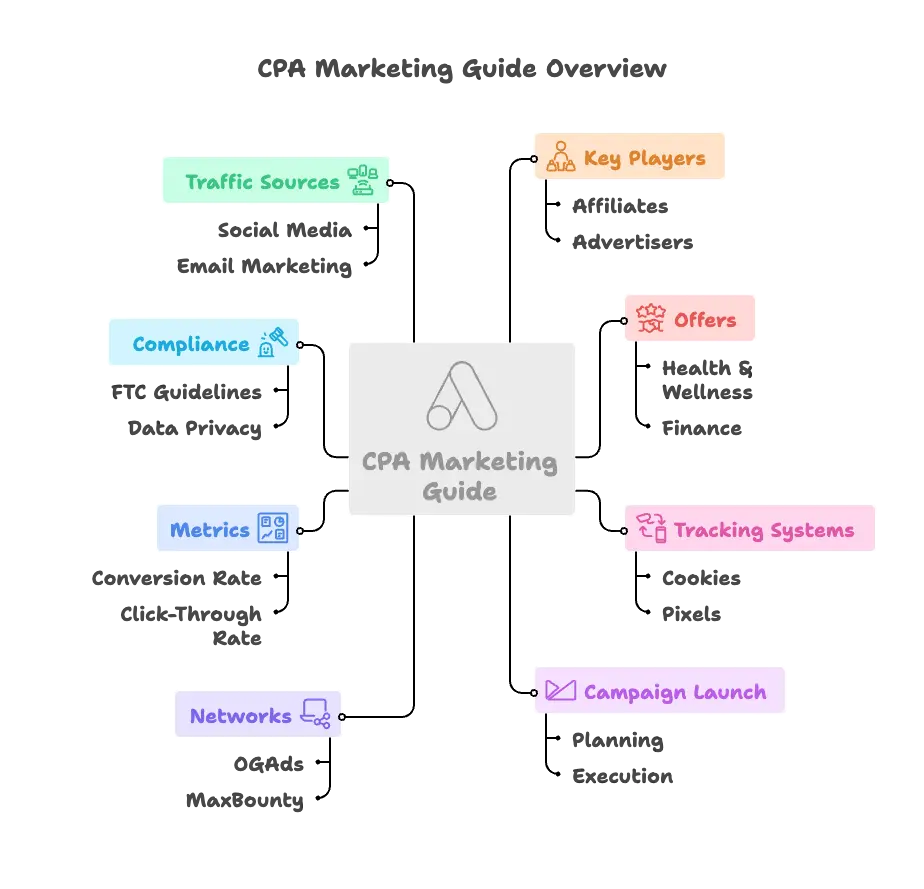
Inside this guide, you’ll find a full breakdown of how CPA marketing works today, the key players you’ll interact with, the types of offers that perform best in 2026, the tracking systems behind every conversion, and the exact steps to launch your first profitable campaign. You’ll also learn how to pick beginner-friendly networks, read your metrics like a pro, avoid compliance issues, and choose traffic sources that match your budget and skills.
Why CPA marketing is beginner-friendly in 2026
In 2026, CPA has become even more accessible thanks to improved tracking systems, better network support, and a huge rise in global offers that require minimal user effort. For beginners, the real appeal is simple: you get paid when people complete small, low-commitment actions, not just purchases. That lowers your learning curve, reduces friction for your audience, and makes it much easier to start seeing results early.
Quick definition of CPA marketing
CPA (cost-per-action) marketing is a performance model where you earn a set payout whenever a user completes a defined action. These actions can be as simple as entering an email, installing an app, creating an account, or signing up for a free trial. You promote a unique tracking link, and each valid action triggers a conversion, your revenue.
How CPA fits into the broader affiliate marketing world
Inside the affiliate industry, CPA is one branch of a much larger tree. Traditional affiliate marketing usually pays only when someone makes a purchase. CPA, however, pays you for non-purchase actions too. That makes it the bridge between “easy to enter” and “high earning potential.” You’re still an affiliate, still promoting offers, still using tracking links, but you’re working with actions that convert far more often than sales, especially in mobile-focused or incentive-friendly niches.
Why actions like leads, installs, and signups make CPA low-friction
People hesitate before spending money. They don’t hesitate to enter an email for a giveaway, download a free app, or sign up to access something interesting. That's the magic of CPA: the actions are simple, quick, and psychologically effortless for users, which means higher conversion rates and more predictable earnings for you. For beginners, this removes the biggest barrier most new affiliates face: trying to convince strangers on the internet to buy something.
What CPA Marketing Is (2026 View)
CPA marketing has evolved into one of the cleanest and most data-driven branches of the performance marketing world. In 2026, it blends classic affiliate principles with modern tracking, AI-powered optimization, and a global supply of offers across mobile apps, fintech, gaming, dating, and sweepstakes. At its core, CPA is simple: you get paid when users complete a specific action, no sale required. But understanding how the ecosystem operates is what separates beginners from those who actually scale.
The Definition of CPA Marketing
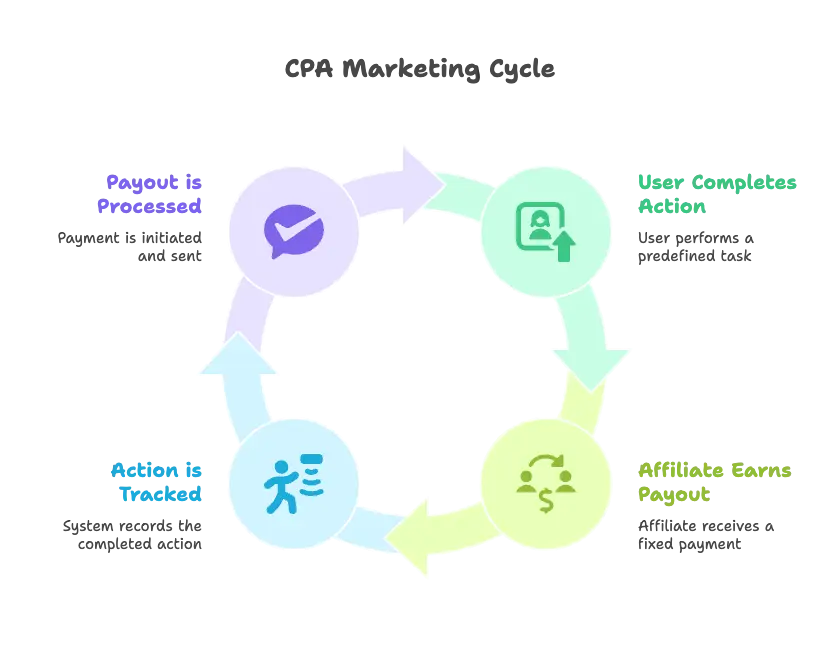
CPA (cost-per-action) marketing is a performance model where affiliates earn a fixed payout each time a user completes a predefined action. That action could be:
- entering an email
- downloading an app
- creating an account
- submitting a form
- completing a purchase
Instead of being paid for traffic, you’re paid for results. The advertiser only spends money when the action they care about is completed, and as the affiliate, your earnings rise in proportion to the quality and volume of those conversions.
How the Model Works (Advertiser → Network → Affiliate)
The CPA ecosystem has three primary players, each with a clear role:
1. Advertiser (Merchant / Brand)
They own the product, app, or service. They decide which actions they want users to complete and how much each action is worth.
2. CPA Network (The Middle Layer)
This is the hub that connects advertisers and affiliates.
The network handles:
- offer distribution
- tracking links & postbacks
- fraud prevention
- reporting & analytics
- affiliate payouts
They manage the technical and financial side so advertisers don’t have to deal with every affiliate directly.
3. Affiliate (You)
You promote offers using traffic sources like TikTok, Google Ads, SEO blogs, push ads, YouTube, or social media. When your audience completes the desired action, the network tracks it and pays you.
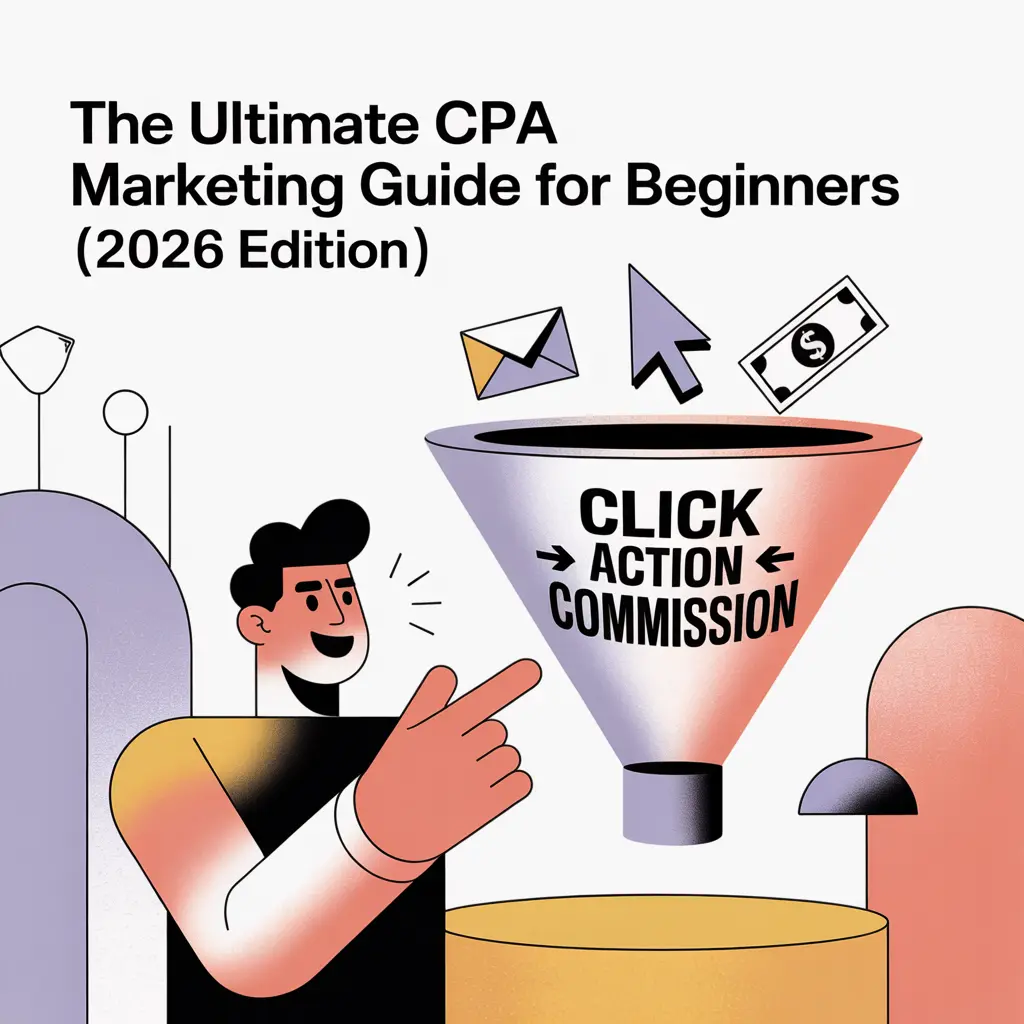
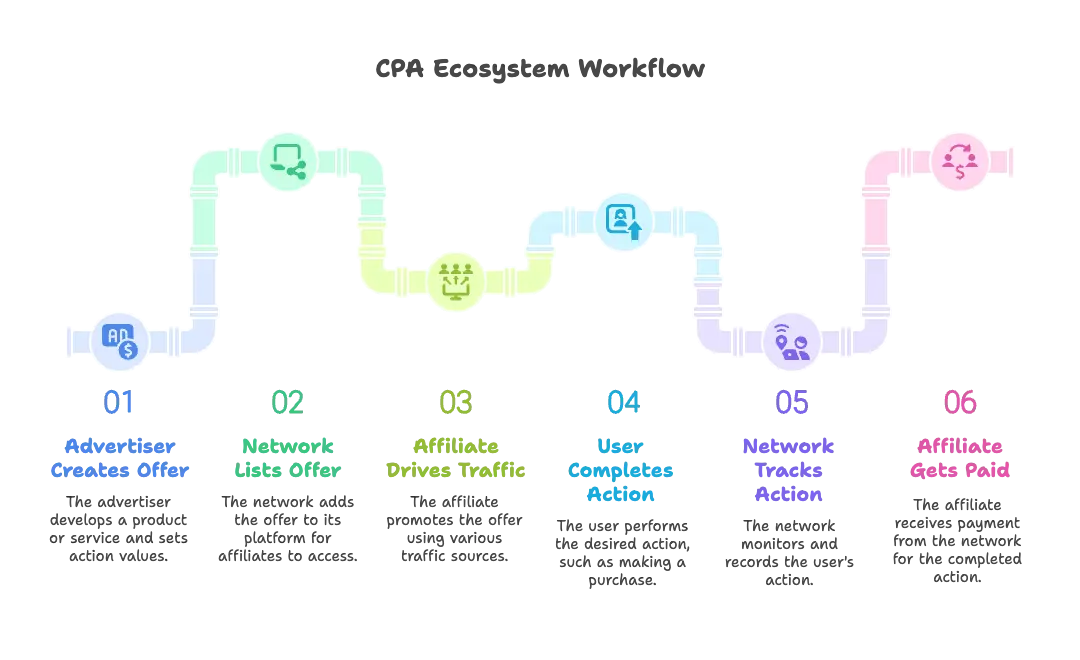
Advertiser creates offer → Network lists offer → Affiliate drives traffic → User completes action → Affiliate gets paid.
Common Action Types (CPL, CPI, CPS, etc.)
CPA is an umbrella term that covers several types of actions:
CPL - Cost Per Lead
The user submits basic info (email, phone number, signup form).
Beginner-friendly, converts easily.
CPI - Cost Per Install
The user installs a mobile app.
Popular in gaming, fintech, and rewards apps.
CPS - Cost Per Sale
The user completes a purchase.
Higher payouts, more friction, often used in ecommerce.
CPA / CPE - Cost Per Action or Engagement
This could be:
- account creation
- survey completion
- watching a video
- submitting a quote form
RevShare (Affiliate Hybrid)
You earn a percentage of customer revenue over time. Common in trading, adult, and subscription niches.
Understanding these action types helps you pick offers that align with your traffic source and audience behavior.
The CPA Formula Explained
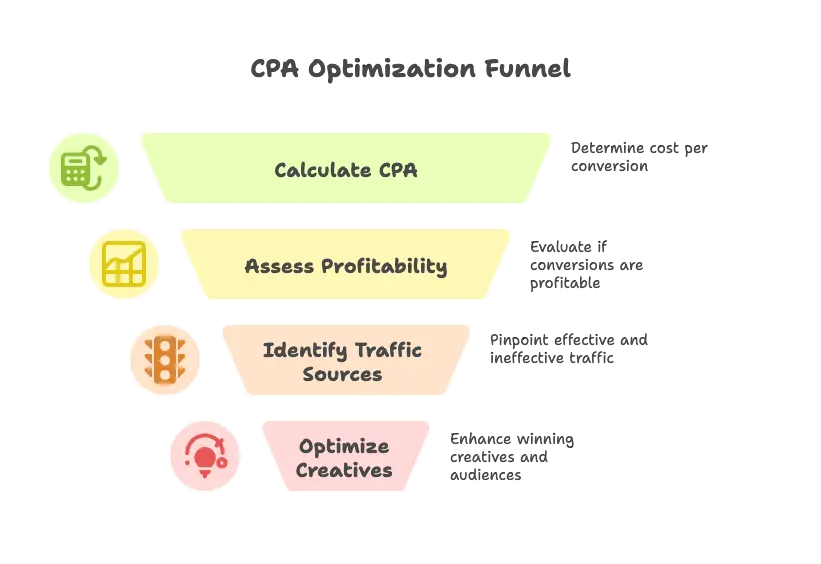
The CPA formula is the backbone of optimization:
CPA= Total Campaign Cost / Number of Conversions
Example:
If you spend $50 and generate 10 conversions:
CPA= 50/10=5
If the payout per conversion is $12, then your profit per conversion is:
12−5=$7
This formula helps you understand:
- whether you’re profitable
- where to cut bad traffic
- which creatives or audiences are winning
- how aggressively you can scale
You’re not guessing, you're measuring.
Why CPA Remains Relevant and Profitable in 2026
CPA has surged in popularity for three reasons:
1. Lower friction actions = higher conversions
People may hesitate to buy, but they don’t hesitate to:
- enter an email
- download an app
- sign up for a giveaway
This naturally boosts conversion rates.
2. Global advertisers are spending more on measurable results
In 2026, brands want performance, not impressions. CPA gives them exactly that, verified actions, not vague traffic.
3. Improvements in tracking & AI targeting
Better tech = fewer tracking issues, cleaner attribution, and smarter optimization. Affiliates get more accurate data, advertisers get more efficient spend, and networks can scale campaigns faster.
4. CPA doesn’t require experience or large budgets
Beginners can start with organic traffic or low-budget tests and still see results.
5. Evergreen niches still booming
Dating, gaming, fintech, sweepstakes, and nutra continue to fuel consistent demand across all geos.
CPA remains profitable in 2026 because it offers high conversion rates, predictable payouts, global demand, and an entry point that doesn’t require advanced marketing experience or upfront capital.
CPA vs Traditional Affiliate Marketing
CPA and traditional affiliate marketing sit on the same spectrum, but they operate with two very different incentives. One rewards you for actions, the other rewards you for sales. Understanding how they differ helps beginners choose the path that matches their skills, budget, and long-term goals. In 2026, both models are thriving, but they’re built for different personalities and traffic strategies.
The Payment Difference (Actions vs Sales)
The clearest dividing line between CPA and traditional affiliate marketing is how you get paid:
CPA Marketing
You earn money when a user completes a simple, predetermined action.
These actions include:
- entering an email
- filling out a form
- installing an app
- creating an account
- completing a free trial
No purchase required.
Traditional Affiliate Marketing
You earn a commission only when a user buys a product or pays for a service.
Examples:
- buying a laptop
- subscribing to software
- ordering supplements
- joining a paid membership
It’s high friction, but high payout.
Summary:
CPA = easier actions, lower payouts.
Affiliate = harder actions, higher payouts.
Risk–Reward Profile Comparison
Both models carry their own form of risk and potential reward:
CPA Risk–Reward
Risk:
- Can require tighter compliance
- Some offers have strict traffic rules
- Networks can reject low-quality leads
Reward:
- Much higher conversion rates
- Faster revenue for beginners
- Easier to test and optimize
Traditional Affiliate Risk–Reward
Risk:
- Sales are harder to generate
- Longer customer decision cycles
- Requires strong content, SEO, or paid ads mastery
Reward:
- Much higher lifetime earnings per customer
- Evergreen builds: blog posts, rankings, email funnels
- Strong passive income potential
CPA is about quick wins and volume, while traditional affiliate marketing is about big commissions and long-term assets.
Why CPA Often Converts Easier for Beginners
New marketers struggle with one thing above all: convincing a cold audience to spend money. CPA removes that pressure entirely.

Users hesitate before buying, but they don’t hesitate to:
- enter a giveaway
- sign up to explore a free app
- download a rewards platform
- unlock a quote or trial
These micro-actions feel low-commitment and effortless, which naturally leads to higher conversion rates. For beginners who are still learning targeting, funnel building, and ad creative strategy, CPA offers a forgiving environment where small mistakes don’t destroy the campaign.
Network Approval Differences
Both CPA and traditional affiliate programs require approval, but CPA networks tend to be more selective, especially with new affiliates.
CPA Network Approval
Networks may ask:
- “What traffic sources will you use?”
- “Do you have a website or landing page?”
- “Have you done affiliate marketing before?”
They want to ensure:
- you’re not sending fraudulent traffic
- you understand basic compliance rules
- you know how to drive legitimate actions
Approval is still possible for beginners, but transparency is essential.
Traditional Affiliate Program Approval
Many programs approve instantly.
Example: Amazon Associates, Impact, Awin, ClickBank.
Some premium programs ask for:
- a website
- existing content
- audience data
But overall, traditional affiliate programs tend to be more flexible.
Which Model Is Better for What Type of Marketer
Both models thrive in 2026, but they serve different strengths:
CPA Is Best For:
- beginners who want quick wins
- creators using TikTok, Shorts, or IG Reels
- paid advertisers testing low-barrier offers
- marketers targeting mobile users globally
- people who want to start without selling
CPA works beautifully when the action is simple and fast.
Traditional Affiliate Marketing Is Best For:
- bloggers building SEO assets
- YouTubers reviewing products
- niche experts or educators
- email marketers building long-term funnels
- creators who prefer high-ticket offers
Traditional affiliate marketing shines when your audience trusts you enough to buy.
CPA is your entry-level, high-conversion gateway to online marketing, while traditional affiliate is your long-term, high-ticket wealth builder. Both work, but the right choice depends on your skills, timeline, and appetite for selling.
The CPA Ecosystem and Key Players
CPA marketing runs on a tightly connected ecosystem where every participant plays a specific role. Once you understand how advertisers, networks, affiliates, and traffic sources fit together, and how tracking glues everything in place, the entire landscape becomes far less mysterious. In 2026, this ecosystem operates with more precision, automation, and data visibility than ever, making it a powerful playground for beginners and experienced marketers alike.
Advertisers
Advertisers are the brands or product owners who want specific actions from users. These are typically companies in niches like:
- fintech (credit cards, trading apps)
- gaming & gambling
- dating apps
- rewards platforms
- ecommerce brands
- health & beauty
They set:
- the action required (email submit, install, signup, sale)
- the payout (how much each action is worth)
- the targeting rules (allowed countries, devices, traffic types)
- compliance requirements (no misleading ads, age restrictions, etc.)
Their goal: acquire high-quality leads or customers at a predictable cost.
Affiliates / Publishers
Affiliates are the marketers, people like you, who drive traffic to these offers.
Affiliates may operate through:
- TikTok, Instagram, YouTube
- SEO websites and blogs
- paid ads (Meta, Google, push, native)
- email lists
- communities & forums
Affiliates choose offers and use their creativity, traffic skills, and audience insights to influence user actions.
Your goal: send valid conversions that meet the advertiser’s criteria and earn consistent payouts.
CPA Networks and What They Actually Do
CPA networks are the “middle layer” between advertisers and affiliates.
Their job is bigger than most beginners realize.
They handle:
- Offer distribution: They host thousands of offers from multiple advertisers.
- Tracking links: They generate your unique affiliate link.
- Fraud prevention: They block fake leads, bots, and harmful traffic.
- Payment processing: They pay affiliates on time (often weekly).
- Reporting & analytics: They show impressions, clicks, conversions, EPC, and more.
- Compliance: They enforce advertiser rules and ensure affiliates follow them.
- Support: Affiliate managers help you pick offers and fix issues.
Without networks, affiliates would need to negotiate individually with brands.
With networks, you get plug-and-play access to hundreds or thousands of offers instantly.
Traffic Sources (Organic + Paid)
Every affiliate chooses how they want to bring users to the offer. Traffic sources fall into two categories:
Organic Traffic
- SEO blogs
- YouTube videos
- TikTok content
- Instagram Reels
- Pinterest boards
- Facebook groups
- Reddit and niche communities
Pros: Free, scalable, builds trust
Cons: Takes time, requires consistent content
Paid Traffic
- Meta Ads (Facebook/Instagram)
- Google Search & Display
- TikTok Ads
- Native ads (Taboola, MGID, Revcontent)
- Push ads (PropellerAds, RichAds)
- Pop traffic
- Display banners
Pros: Fast testing, predictable scaling
Cons: Costs money, requires strict optimization
Your ideal traffic source depends on your niche, budget, and experience.
For example:
- Dating: TikTok or push traffic
- Finance: Google Search + SEO
- Gaming: Native ads + TikTok
- Sweepstakes: Push + pop traffic
How All Players Interact in a Live Campaign
Here’s how the ecosystem moves when your campaign is running:
- Advertiser creates an offer
Example: a trading app pays $20 for every verified signup.
- CPA network lists the offer
It adds tracking links, rules, payouts, creative assets, and geos.
- Affiliate chooses the offer
You decide, “I can promote this to my TikTok finance audience.”
- Affiliate sends traffic
You make a video recommending the app and include your tracking link.
- User clicks the link
The network logs the click.
- User completes the required action
They sign up and verify their account.
- Network records the conversion
Their system matches the conversion to your click.
- Advertiser approves the conversion
Valid signups = accepted conversions.
- Network pays the affiliate
Your balance updates with the earned payout.
This loop repeats thousands of times for high-volume affiliates.
Why Tracking & Attribution Matter Before Scaling
Tracking is the backbone of CPA marketing. Without accurate attribution, you’re flying blind.
Here’s why it matters:
1. You need to know which traffic works
If you can’t see:
- which ad
- which creative
- which audience
- which device
- which placement
is generating conversions, you can’t optimize or scale.
2. Tracking protects your earnings
Proper postbacks and pixel setups prevent:
- missed conversions
- lost revenue
- unattributed sales
- compliance disputes
3. Scaling without tracking burns money
Beginner affiliates often run into trouble when they start spending real money without clean tracking. You need to understand:
- your true CPA
- your real EPC
- your ROI per placement
4. Advertisers care about lead quality
If your results look suspicious or untrackable, conversions may be rejected, and your account may be reviewed.
Good tracking turns CPA from gambling into a data-driven business. It’s the difference between hoping a campaign works and engineering it to work.
Popular Niches & High-Performing Offer Types (2026)
In 2026, CPA marketing continues to thrive because certain niches reliably convert across geographies, devices, and traffic channels. These verticals work for two major reasons: (1) user intent is strong, and (2) the required action is simple, creating consistently high conversion rates. Below are the niches dominating the industry this year, and why they’re ideal for beginners and advanced affiliates alike.
Dating & Relationship Offers
Dating has always been a powerhouse in CPA, and in 2026 it’s stronger than ever. With new matchmaking apps, niche dating platforms, and AI-driven chat experiences, the demand is constant and global.
Why it converts:
- Low friction actions (signup, email submit, app install)
- High emotional motivation, people want connection
- Works extremely well with short-form content on TikTok, Reels, and Shorts
- Strong performance on push ads, native ads, and SMS traffic
Common payout types:
- Cost Per Registration (CPR)
- Cost Per Lead (email/phone submit)
- App install (CPI)
- RevShare via premium upgrades
Best for: affiliates who love creative angles, storytelling, social content, and viral-style traffic.
Finance & Fintech
Finance is one of the highest-paying verticals in CPA because advertisers value verified leads, account signups, and funded accounts. In 2026, fintech apps, trading platforms, and credit-building tools dominate the space.
Why it converts:
- Extremely high payouts (sometimes $20–$150+)
- Strong demand for financial tools, especially mobile apps
- Global expansion of neobanks and investment platforms
- Works extremely well with SEO, YouTube, Google Search, Reddit, and influencer content
Common payout types:
- Signups for credit cards or loan platforms
- Trading app installs → KYC → activated user
- Credit-building app registrations
- Lead forms for insurance or personal loans
Best for: affiliates who can simplify complex topics, run compliant ads, or build content-driven audiences around money, credit, and investing.
Gaming & iGaming
Gaming continues to be one of the fastest-growing CPA verticals, fuelled by mobile demand, esports culture, and global interest in casino and sports betting offers.
Why it converts:
- Huge mobile user base
- Simple actions (install, register, first deposit for CPS)
- Strong engagement from younger audiences
- High retention and lifetime value for advertisers
Common payout types:
- CPI for mobile games
- Registration for casino or sportsbook platforms
- First deposit bonuses (higher payout CPS)
Best for: affiliates running TikTok gaming content, push ads, native ads, pop traffic, or channels with strong entertainment value.
Sweepstakes & Giveaways
Sweepstakes (also known as “sweeps”) remain one of the most beginner-friendly CPA niches. The action is usually an email submit, which means conversions can explode on high-volume traffic.
Why it converts:
- Extremely low friction (user enters email or phone number)
- High CTR from eye-catching creatives (“Win an iPhone 15!”)
- Works across almost any traffic source
- Scales easily across Tier 1, Tier 2, and Tier 3 countries
Common payout types:
- CPL (email submit)
- SOI/DOI (single/double opt-in)
- SMS submits
Best for: affiliates leveraging push, pop, native ads, TikTok virals, and broad-interest audiences.
Health, Beauty, Nutra
The nutra market (health & wellness products) remains a giant in CPA because it taps into evergreen desires: looking better, feeling better, and solving common health issues.
Why it converts:
- Emotional pain points (weight loss, skincare, supplements)
- Massive consumer interest year-round
- Works well with advertorial-style landing pages
- High payouts for trials, subscriptions, and samples
Common payout types:
- Free trial signup
- Sample request
- Supplement purchase (CPS)
- Multi-step funnels with upsells
Best for: affiliates comfortable writing persuasive content, advertorials, or story-driven ads.
How to Choose Your First Profitable Vertical
Choosing the right vertical is one of the most important decisions you’ll make as a beginner. Here’s a simple framework to help you pick one that fits your strengths and resources:
1. Match your traffic source to the niche
- TikTok → dating, gaming, sweepstakes
- Google Search → finance, insurance, health
- Push ads → dating, sweeps, gaming
- YouTube → finance, nutra, educational offers
You don’t choose a niche in isolation; you match it to the platform you’re using.
2. Choose niches with simple, clear actions
If you’re new, start with:
- email submits
- app installs
- simple registrations
Avoid complex funnels or multi-step verification as your first campaign.
3. Pick a niche you can create angles for
If you enjoy:
- entertainment → gaming
- self-improvement → finance & nutra
- lifestyle & relationships → dating
- viral curiosity → sweepstakes
You'll naturally create better content.
4. Start with one niche, master it, then expand
Jumping around kills momentum. Pick one vertical, understand its audience, learn the patterns of top-performing offers, and scale horizontally once you’ve found success.
Your first profitable vertical is the one where your traffic source, content style, and offer complexity all align. Low friction + high demand + your natural strengths = fast wins.
How CPA Tracking Works
Tracking is the engine that powers CPA marketing. Without it, networks wouldn’t know which affiliate drove which lead, advertisers couldn’t validate conversions, and you wouldn’t know whether your campaigns are profitable. In 2026, tracking systems have become more accurate, privacy-compliant, and flexible, especially with server-to-server (S2S) tracking becoming the industry standard.
This section breaks down the tracking process in simple, beginner-friendly terms so you understand exactly how your conversions are recorded and paid.
The Tracking Link Process (Click → Cookie/S2S → Conversion)
When you promote a CPA offer, the network gives you a unique tracking link. This link contains your affiliate ID, offer ID, and sometimes extra parameters (like subIDs) you can use for tracking your traffic sources.
Here’s what happens step-by-step:
1. User clicks your affiliate link
The moment they click, the CPA network logs:
- the click
- your tracking parameters
- the user’s device and IP
- the timestamp
2. Tracking method fires (cookie or S2S)
Two standard methods are used:
Cookie-Based Tracking
A cookie is placed on the user’s browser so the network can recognize them later when they complete the action.
S2S (Server-to-Server) Tracking
This method doesn’t rely on cookies.
Instead, the advertiser sends a secure signal directly to the network’s server when the action is completed.
S2S is more reliable, especially on mobile.
3. User completes the action
When the user signs up, downloads an app, or submits a form, the advertiser fires a “conversion event.”
4. Network records the conversion
The network matches:
- the click
- the user
- the action
If everything lines up, your conversion shows in the dashboard and your balance increases.
Matching Actions with Affiliates
After the user completes the action, the advertiser must confirm who drove that lead. This is done using identifiers passed through your tracking link.
Common identifiers include:
- click ID
- transaction ID
- affiliate ID
- subIDs (optional labels you add for deeper tracking)
Example scenario:
- You send traffic using your link → Network logs Click ID 8F2D.
- User signs up → Advertiser sends back “8F2D converted.”
- Network matches that conversion to your account.
This matching ensures:
- affiliates get paid for valid actions
- networks can filter out fraudulent or duplicated traffic
- advertisers receive accurate attribution
Postbacks, Pixels, and Parameters Explained Simply
Tracking tools help the network verify conversions and help you analyze your performance.
Postback URL (S2S Callback)
A postback is a URL that the advertiser “fires” back to the network when a conversion happens.
Think of it as the advertiser saying:
“Yes, this user completed the action. Pay the affiliate.”
Pixel Tracking
This method uses a small, invisible image or script that loads when the action is completed.
It’s less accurate than S2S but still used in some web funnels.
Parameters (subID1, subID2, etc.)
SubIDs let you track:
- which ad
- which placement
- which audience
- which landing page
generated the conversion.
Example:
?sub1=tiktok_ad_1&sub2=female18-24
These parameters show up in your dashboard so you know exactly what’s working.
Dashboard Analytics (Impressions → Clicks → Conversions → Revenue)
Every CPA network dashboard shows the same core metrics:
1. Impressions
How many people saw your ad or landing page.
2. Clicks
How many people clicked your affiliate link.
3. Conversions
How many people completed the required action (email submit, install, signup, etc.)
4. Earnings / Revenue
Your total payout from accepted conversions.
Additional metrics include:
- EPC (earnings per click)
- CR (conversion rate)
- Payouts per country
- SubID performance
- Offer approval or rejection breakdown
This data is crucial because it tells you whether your campaign is profitable or needs adjustments.
Reading Data to Identify Optimization Opportunities
Understanding your tracking data is where CPA marketing becomes an actual business.
1. Low CTR (click-through rate) → Creative problem
If many people see your ad but few click:
- try a new thumbnail
- change the hook
- use stronger benefits
- modify the angle
2. High CTR but Low Conversions → Landing page or offer mismatch
This means:
- users are interested
- but not completing the action
Fixes:
- rewrite the landing page
- improve the pre-sell
- switch to a better-converting offer
3. High CPA (cost per action) → Targeting or bidding issue
If you’re paying too much for each conversion:
- refine your audience
- adjust bids
- cut bad placements
- improve your creative relevance
4. One subID outperforming others → Scale it
If one audience or creative is delivering the most conversions:
- increase budget there
- pause underperformers
- duplicate winners with variations
5. Sudden drop in conversions → Technical or compliance issue
Possible causes:
- postback not firing
- tracking broken
- network pausing the offer
- advertiser rejecting leads
Always check with your affiliate manager when something looks off.
Tracking is not just a technical requirement, it’s the compass that tells you where profit lives. Master it early, and every campaign you launch becomes predictable, optimizable, and scalable.
Step-By-Step: How to Get Started in CPA Marketing (Beginner Roadmap for 2026)
This roadmap is built for beginners who want a clean, proven, and repeatable process for launching their first profitable CPA campaign. No guesswork, no overwhelming jargon, just a clear sequence that takes you from zero to your first conversions.
Choose a Niche
Your niche determines:
- the type of offers you promote
- the traffic platforms you’ll use
- the style of content you’ll create
- how competitive your campaigns will be
Beginner-friendly niches in 2026 include:
- Dating
- Finance (credit-building apps, budgeting tools)
- Gaming (mobile apps, casino registrations)
- Sweepstakes (email submits, giveaways)
- Health & beauty
How to choose:
- Pick a niche that aligns with your interests or content style.
- Choose one with simple conversions (email submit, install, registration).
- Avoid niches with heavy compliance (crypto, insurance) until you gain confidence.
Rule of thumb:
Start with one niche and stick to it for at least 30 days. Mastery beats randomness.
Build a Simple Online Presence / Landing Page
You can run direct-link campaigns, but beginners see better conversions with a landing page.
A landing page lets you:
- pre-sell the offer
- warm up the user
- comply with ad platform rules
- create a consistent message
- add curiosity or storytelling
Types of beginner-friendly landing pages:
- Quiz pages (“Find your perfect dating match”)
- Simple blogs or review pages
- Short form pre-sell pages
- App recommendation pages (“Top 3 apps paying $10 a day”)
Use tools like:
- WordPress
- Carrd
- Systeme.io
- Swipe Pages
You only need one clean, high-converting page to start.
Apply to CPA Networks (Approval Tips)
CPA networks want affiliates who understand the basics, they’re not looking for perfection, just clarity and honesty.
What to include in your application:
- Your planned traffic sources (e.g., TikTok, SEO, Meta Ads)
- Your niche focus
- Your landing page or simple website
- A brief explanation of how you'll promote offers
Avoid saying things like:
- “I want to try everything.”
- “I have no experience.”
- “I’m here to test whatever works.”
Instead, show you're organized.
Beginner-friendly networks include:
- Mobidea
- CPALead
- Adsterra
- PerformCB
- OGAds (especially strong for mobile + content creators)
Pro tip:
Reach out to an affiliate manager. Human contact can fast-track approval.
Pick Beginner-Friendly Offers
The best offers for beginners have:
- simple actions
- strong EPC
- broad appeal
- flexible traffic rules
Look for:
- SOI/DOI email submits
- dating signups
- mobile app installs
- sweepstakes entries
- “trial signup” offers
Avoid complex offers like:
- multi-step banking verifications
- deposit-required gambling offers
- expensive CPS ecommerce deals
How to evaluate an offer quickly:
- EPC higher than network average
- Allowed on your traffic source
- Simple and fast user action
- Good advertiser reputation (check reviews)
Choose Your First Traffic Source
Pick one traffic platform and master it. Do not attempt to use every source at once.
Best beginner choices:
Organic:
- TikTok
- YouTube Shorts
- Instagram Reels
Paid:
- Push ads
- Native ads
- Facebook/Instagram ads (with simple funnels)
Match niche to traffic:
- Dating → TikTok, push, native
- Finance → Google Search, SEO, YouTube
- Gaming → TikTok, push
- Sweepstakes → push, pop, native
- Health/nutra → SEO, advertorials, native ads
Your traffic source determines your entire strategy, so choose one that fits your strengths.
Launch Test Campaigns (Low-Budget Testing Strategy)
Before scaling, you must test.
If using paid ads:
Start with:
- $5–$10/day budgets
- 3–5 creatives
- 2–3 angles
- 1–2 audiences
Your goal is simple: find combinations that produce conversions at a reasonable CPA.
If using organic traffic:
Test multiple:
- video hooks
- angles
- landing page variations
- calls to action
Track performance with subIDs:
- sub1 = creative
- sub2 = audience
- sub3 = placement
Testing is not about profit, it’s about identifying what works.
Optimize and Scale Winners
Once you find a creative, audience, or angle that consistently brings conversions, begin scaling methodically.
Optimization steps:
Pause underperformers
Cut ads with low CTR or high CPA.
Refine your landing page
Improve the headline, visuals, or CTA.
Improve audience targeting
Narrow your interest groups or demographics.
Scaling steps:
- Increase budget slowly (20–30% increments).
- Duplicate winning campaigns into new ad sets.
- Expand into new geos with similar behavior.
- Try new creatives built around the same winning angle.
Golden rule:
Scale only when:
- CPA < payout
- EPC > cost per click
- Conversion rate is stable
Scaling too early burns money.
Scaling too late wastes potential.
Scaling at the right time builds momentum.
Key CPA Metrics Every Beginner Must Know
If CPA marketing is the engine, then metrics are the dashboard. They tell you what’s working, what’s wasting money, and where the profit is hiding. Even the most skilled affiliates rely heavily on these numbers to guide decisions, optimize campaigns, and scale safely.
For beginners, mastering these four core metrics, CPA, EPC, conversion rate, and profit margin, is the difference between running blind and running a real business.
CPA (Cost Per Action)
Definition:
CPA represents how much you spend to generate one conversion.
Formula:
CPA=Total Spend/Number of Conversions
Example:
If you spend $40 and get 10 conversions:
CPA=40/10=4
Why it matters:
This metric tells you how efficient your campaigns are. Your CPA must be lower than the offer payout to be profitable.
If an offer pays $12 and your CPA is $6? You’re profitable.
If the offer pays $5 and your CPA is $8? You’re losing money.
EPC (Earnings Per Click)
Definition:
EPC tells you how much you earn on average per click you send.
Formula:
EPC=Total Earnings/Number of Clicks
Example:
If you earn $60 from 200 clicks:
EPC=60/200=0.30
You earn $0.30 per click on average.
Why it matters:
- High EPC = a strong offer
- Low EPC = weak offer or bad traffic
- Comparing EPC across offers helps you pick the best performer
EPC is especially useful for beginners who are testing multiple offers with the same audience.
Conversion Rate (CR)
Definition:
Conversion rate tells you what percentage of your clicks turn into actual actions.
Formula:
CR=Conversions/Clicks × 100
Example:
20 conversions from 400 clicks:
CR=20/400 × 100 = 5%
Why it matters:
A high conversion rate means:
- strong user intent
- good landing page
- relevant targeting
- good offer–audience match
A low conversion rate means:
- poor offer fit
- weak landing page
- wrong traffic source
- misleading angle
For beginners, improving conversion rate is often the fastest way to boost profit.
Profit Margin Basics
Profit margin shows how much money you keep after ad spend.
Formula:
Profit Margin= Revenue−SpendRevenue × 100
Example:
You make $200 in revenue and spend $120 on ads:
Margin=200−120/200 × 100= 40%
Why it matters:
- High margin = safe scaling
- Low margin = riskier campaigns
- Negative margin = stop and optimize
Beginners often look only at revenue and forget spend. Professionals obsess over margins.
How Beginners Should Use These Numbers to Scale
Here’s the practical way to use your metrics like a pro:
1. Use CPA to decide when to pause or kill campaigns
If your CPA is consistently above the payout, pause and fix:
- your targeting
- your creatives
- your funnel
Don't scale a losing campaign hoping it will magically improve.
2. Use EPC to identify the winning offers
If Offer A has a $0.80 EPC and Offer B has $0.25 EPC with the same traffic, Offer A is the clear winner.
Scale the offer that gives you the most money per click.
3. Use conversion rate to fix bottlenecks
Low CR?
- Improve your landing page
- Test new hooks
- Align your traffic with the right audience
- Clarify your call-to-action
High CR means you’re close to profit, keep optimizing.
4. Use profit margin to scale safely
If your margin is above 25–30% consistently, you can:
- increase ad budget
- expand to new audiences
- duplicate winning campaigns
- test more creatives
If margin drops below 10%, hold off on scaling and refine your funnel.
5. Track everything with SubIDs
SubIDs reveal exactly which creative, audience, or landing page brought the conversion.
This helps you:
- cut losers
- scale winners
- avoid wasted ad spend
Beginners who properly use SubIDs often outperform experienced affiliates who don’t.
These four metrics tell you the truth about your campaign.
Learn them early, use them daily, and you’ll scale confidently instead of guessing.
Beginner-Friendly CPA Networks & Comparison Table
Choosing the right CPA network is one of the most important decisions for new affiliates. Different networks specialize in different niches, payout models, geos, and traffic rules, and picking the wrong one can slow your growth before you ever launch a campaign.
Below is a curated list of the most beginner-friendly CPA networks for 2026, a breakdown of their strengths, and a comparison table to help you choose quickly and confidently.

List of Recommended CPA Networks
These networks are ideal for beginners due to easy approvals, strong support, high-quality offers, and clear tracking systems.
1. OGAds
A favourite for content creators promoting mobile apps, make-money apps, sweepstakes, and downloads.
2. MaxBounty
One of the largest and longest-running CPA networks globally, offering thousands of offers across dating, sweepstakes, finance, insurance, surveys, and mobile. Known for reliable payments and strong beginner support.
3. Adsterra (CPA Division)
Well-known ad network offering CPA deals, push offers, sweeps, and gaming offers.
4. PerformCB
Premium network with strict compliance but high-quality advertisers, especially in finance and mainstream verticals.
5. Mobidea
Mobile-focused network with top-performing dating, finance, gaming, and nutra offers.
6. RichAds List of Dating CPA Networks
A curated collection of high-performing dating networks for 2025–2026.
7. Affpaying (Directory)
Not a network, but a massive directory where affiliates compare CPA networks with real reviews.
8. Affbank (Directory)
Offer comparison tool and network directory with filters for geos, payouts, and niches.
Feature Summary (Focus, Approval Difficulty, Niche Strength)
Mobidea
- Focus: Mobile, dating, finance, gaming, nutra
- Approval: Easy
- Strength: Smartlink options, global coverage
Adsterra
- Focus: Sweeps, dating, gaming, utilities
- Approval: Beginner-friendly
- Strength: Strong for push, pop, and display traffic
PerformCB
- Focus: High-quality offers, finance, insurance, ecommerce
- Approval: Medium (they want clear traffic plans)
- Strength: Premium advertisers, high payouts
OGAds
- Focus: App installs, rewards apps, make-money apps
- Approval: Easy to medium
- Strength: Great for TikTok influencers, YouTube creators, social traffic
RichAds Dating Network List
- Focus: Dating CPA networks
- Approval: Varies by network
- Strength: Perfect for affiliates running push, native, and TikTok dating ads
Affpaying
- Focus: Directory of networks
- Approval: N/A
- Strength: Reviews + comparisons for hundreds of networks
Affbank
- Focus: Offer comparison
- Approval: N/A
- Strength: Helps you find highest-paying offers in your niche
Full Comparison Table
Network / Resource | Main Focus | Approval Difficulty | Best Niches | Best Traffic Sources |
| MaxBounty | Large, diverse offer marketplace | Medium | Sweepstakes, dating, finance, surveys, mobile apps | Social media, SEO, native ads, paid ads |
Mobidea | Mobile-first CPA network | Easy | Dating, finance, gaming, nutra | TikTok, push ads, native, mobile SEO |
Adsterra (CPA) | High-volume CPA offers | Easy | Sweepstakes, dating, utilities, gaming | Push, pop, display, native |
PerformCB | Premium advertiser network | Medium | Finance, insurance, ecommerce | Google Search, YouTube, Meta Ads |
OGAds | App installs & rewards apps | Easy–Medium | Make-money apps, mobile apps, downloads | TikTok, YouTube, IG Reels, SEO |
RichAds Dating List | Curated dating networks | Varies | Dating & relationship offers | TikTok, push ads, native ads |
Affpaying | Network directory & reviews | N/A | All verticals | Used for research & comparison |
Affbank | Offer comparison engine | N/A | All verticals | Used for finding high EPC offers |
How to Choose a Network Based on Your Traffic Source
Choosing a CPA network is not random, it must match your traffic source and niche. Use this quick guide:
If you're using TikTok, Instagram Reels, or YouTube Shorts:
Choose:
- OGAds → best for mobile apps, money apps
- Mobidea → strong mobile & dating offers
- RichAds Dating List → explosive conversion in dating vertical
Why: Short-form video thrives with simple, curiosity-driven actions like app installs and dating signups.
If you're using Google Search or SEO blogs:
Choose:
- PerformCB → high-quality finance & insurance offers
- Mobidea → mobile SEO, finance apps
- Adsterra (for sweeps SEO pages)
Why: Search traffic performs best with high-intent niches (finance, credit cards, insurance).
If you're using push ads, pop traffic, or native ads:
Choose:
- Adsterra
- Mobidea
- RichAds Dating Networks
Why: These paid traffic formats excel with broad-appeal verticals like dating, sweeps, gaming, and utilities.
If you're using YouTube (long-form):
Choose:
- PerformCB
- OGAds
- Mobidea
Why: YouTube allows deeper explanations, making it perfect for finance and app review funnels.
If you’re using social communities (Facebook groups, Reddit, Discord):
Choose:
- OGAds
- Mobidea
Why: Communities respond well to low-barrier offers like apps, giveaways, and simple signups.
Beginner-Friendly Recommendation:
Start with one network that aligns with your traffic source. Build a relationship with an affiliate manager. Once you understand what converts, expand into additional networks for higher payouts and more competitive offers.
Proven Traffic Strategies That Work in CPA
In CPA marketing, traffic is everything. Even the best offer won’t convert if the people landing on it aren’t primed to take action. In 2026, the winning affiliates are the ones who understand that not all traffic is created equal, each source has its own psychology, strengths, and best practices.
Below are the most dependable traffic strategies dominating CPA this year, along with clear guidance on which niches they pair with and how to create ads that convert fast.
Search Intent Traffic (SEO, Google Ads)
Search intent traffic is the most high-quality and consistent traffic source in CPA. These users are actively searching for solutions, making them easier to convert, especially in high-value niches like finance and health.
SEO (Search Engine Optimization)
SEO traffic is free, long-term, and trust-based.
Examples:
- “Best dating apps 2026”
- “How to build credit fast”
- “Top trading apps for beginners”
- “Best sweepstakes sites”
Strengths:
- High-intent audience
- Evergreen traffic
- Strong conversion rates
- Perfect for review-style content
Best for:
Finance, insurance, nutra, gaming, credit-building, loans.
Google Ads
Google Ads let you bid on keywords matching user intent.
Example:
- “open brokerage account”
- “best loan apps”
- “free dating site signup”
Strengths:
- Extremely high-intent
- Fast results
- Precise targeting
Best for:
Finance, insurance, utilities, legal, health, credit apps.
Social & Video (TikTok, IG Reels, YouTube Shorts)
Short-form video is the king of speed, virality, and massive reach in 2026. It’s a perfect match for low-friction CPA actions like app installs and simple signups.
TikTok
The fastest-growing traffic source for CPA offers.
Why it works:
- Emotion-driven impulse actions
- Viral potential
- Perfect for dating, gaming, sweepstakes, and app installs
Examples of winning formats:
- “Apps I wish I knew sooner”
- “This dating hack is going viral”
- “Games that pay you to play”
Instagram Reels
Similar to TikTok but with a slightly older demographic.
Works well for:
- Beauty & nutra
- Lifestyle apps
- Finance “tips & tools” content
YouTube Shorts
Best for:
- App reviews
- Make-money apps
- Gaming
Shorts also push viewers into long-form videos where you can build deeper trust.
Strengths of social & video traffic:
- Free or low-cost
- Rapid testing
- High engagement
- Great for affiliates without big budgets
Paid Ads (Native, Push, Display)
Paid traffic is the fastest way to scale CPA campaigns, especially mid- to high-volume offers.
Native Ads (Taboola, MGID, Revcontent)
Native ads blend into news sites as recommended articles.
Best for:
- Nutra
- Sweepstakes
- Dating
- Make-money
- Health & wellness
Why it works:
- Easy to scale
- Strong storytelling potential
- High CTR with good thumbnails
Push Ads (PropellerAds, RichAds, MegaPush)
Push notifications appear on users’ devices directly.
Best for:
- Dating
- Sweeps
- Gaming
- Mobile utilities
Strengths:
- Extremely cheap traffic
- Fast testing
- Global scale
Display Ads (Adsterra, HilltopAds)
Banner ads on websites and apps.
Best for:
- Utilities
- VPNs
- Antivirus apps
- Mobile downloads
Which Traffic Source Pairs Best With Each Niche
Here is a simple cheat sheet for choosing the right traffic source by niche:
Niche | Best Traffic Sources |
Dating | TikTok, Instagram, Push ads, Native ads |
Finance / Fintech | Google Search, SEO, YouTube, Meta Ads |
Gaming & iGaming | TikTok, YouTube Shorts, Push, Native |
Sweepstakes | Push ads, Pop traffic, Native ads |
Health & Nutra | SEO, Native ads, Facebook ads (strict compliance) |
App Installs / Rewards Apps | TikTok, YouTube Shorts, OGAds-style funnels |
Matching the wrong traffic source with a niche is one of the biggest reasons beginners fail.
Matching the right source creates instant momentum.
How to Craft Creatives With High CTR & Conversion Rates
Winning creatives follow a formula: strong hook → clear benefit → simple CTA.
1. Start With a Scroll-Stopping Hook
Examples:
- “This app pays you to walk.”
- “I tested the top 3 dating apps so you don’t have to.”
- “Nobody is talking about this credit hack…”
Hooks should be:
- bold
- curiosity-driven
- emotionally triggering
2. Focus on the Benefit, Not the Feature
Don’t say:
- “This is a trading app.”
Say:
- “This app gives new users $10 for signing up.”
3. Use Native-Style Visuals
- Real people
- Phone screen recordings
- POV demos
- Simple captions
- Bright contrast
Overly polished ads often underperform in CPA.
4. Add Urgency or Social Proof
- “Only available in your country.”
- “Limited spots for new users.”
- “10,000+ people already signed up today.”
These cues dramatically improve conversion rates.
5. End With a Clear CTA
Examples:
- “Try it now.”
- “Sign up free.”
- “Download to start.”
- “Take the quiz.”
Your creative should make the next step obvious.
In short:
The best CPA creatives are fast, punchy, curiosity-driven, and designed to get the click immediately.
Compliance, Regulations & Staying Safe
Compliance is the backbone of long-term success in CPA marketing. While the earnings can be fast and exciting, ignoring rules is the quickest way to lose accounts, payments, or even entire traffic sources. In 2026, platforms and advertisers are stricter than ever, meaning affiliates must understand the boundaries before launching campaigns.
This section gives you a clear, beginner-friendly foundation for staying compliant, protecting your accounts, and keeping your payouts safe.
Offer Rules & Restrictions (Geo, Device, Traffic Type)
Every CPA offer includes a set of rules. Ignoring them, even accidentally, can lead to:
- reversed conversions
- account warnings
- payout holds
- permanent bans
Key restrictions to watch:
1. GEO Restrictions
Some offers only accept traffic from specific countries.
Example:
“US, CA, UK only.”
Sending traffic from India? → Conversions won’t count.
2. Device Restrictions
Some offers convert only on certain devices.
Examples:
- “iOS only”
- “Android only”
- “Desktop only”
Sending desktop traffic to a mobile offer = wasted spend.
3. Traffic Type Restrictions
The most important rule category.
A CPA offer may allow or ban:
- incentive traffic
- TikTok ads
- Facebook ads
- adult traffic
- push notifications
- email traffic
- brand bidding
Always check the “Allowed Traffic Types” section before you promote anything.
4. Landing Page / Creative Restrictions
Common rules include:
- no fake testimonials
- no unrealistic claims (“earn $500 today”)
- no altered advertiser logos
- no misleading countdown timers
Advertisers reject leads fast if your page violates these rules.
Avoiding Bans on Meta, Google, TikTok
Each platform has its own strict policies, and CPA affiliates walk a fine line.
Meta (Facebook/Instagram)
Avoid:
- unrealistic income claims
- misleading before/after images
- using “you” in sensitive contexts
- financial promises
- restricted industries (crypto, dating, gambling without approval)
Use:
- compliant language
- neutral, benefit-oriented ad copy
- high-quality landing pages
Google Ads
Avoid:
- brand bidding unless explicitly allowed
- cloaking
- deceptive claims
- misleading countdowns
- restricted niches like gambling (without certification)
Stick to:
- high-intent keywords
- transparent landing pages
- value-driven copy
TikTok
Avoid:
- exaggerated earnings content
- deceptive “get rich quick” hooks
- unsafe or controversial content
- direct money claims
Use:
- authentic-feeling UGC style
- storytelling
- subtle promotion
- strong curiosity without deception
General Rule:
If it feels sketchy or too good to be true, the platform will ban it.
Privacy, Consent, and Tracking Rules
Even beginners must respect modern privacy laws.
Key regulations affecting CPA:
- GDPR (EU)
- CCPA (California)
- ePrivacy Directive
- Platform-level consent requirements
What you must do:
- Use cookie banners where required
- Get consent before tracking users
- Never store personal info without permission
- Never scrape emails
- Never misrepresent data collection
CPA is safe when done right, but dangerous if you ignore privacy rules.
Working With Affiliate Managers the Right Way
Your affiliate manager (AM) is your lifeline in CPA marketing. They can unlock:
- private offers
- higher payouts
- insider advice
- landing pages
- reduced restrictions
How to work well with your AM:
- Be honest about your traffic sources
- Ask questions when unsure
- Report issues early (low conversion rate, broken links)
- Don’t send prohibited traffic
- Don’t ask for “cloaking tips” or shady tactics
Affiliate managers help serious marketers.
If you treat them like partners, they’ll treat you like a VIP.
How to Stay Compliant in Regulated Niches (Finance, Nutra, Gambling)
These niches have high payouts, and high scrutiny.
1. Finance / Fintech
Regulated because it involves money, credit, and personal data.
Rules to follow:
- No income promises
- No “guaranteed approval” language
- Use advertiser-approved creatives
- Avoid fear tactics
2. Nutra (Health & Beauty)
Highly sensitive due to medical claims.
Avoid:
- “Cure,” “reverse,” or “guaranteed results”
- Overly dramatic before/after images
- Medical-sounding language unless scientifically backed
Use:
- lifestyle imagery
- soft benefits
- compliant advertiser copy
3. Gambling / iGaming
Regulated heavily worldwide.
Avoid:
- promoting to minors
- “risk-free” language
- unlicensed casinos in restricted geos
- encouraging irresponsible behavior
Follow:
- geo rules exactly
- age-verification requirements
- legal disclaimers if required
Compliance is the difference between long-term income and a banned account. Learn the rules, follow them closely, and your CPA business becomes both profitable and stable.
Additional Resources & Recommended Reading
The fastest way to grow in CPA marketing is to learn from reliable sources. While this guide gives you the full foundation, continuing your education through trusted platforms, blogs, directories, and videos will help you stay ahead of industry changes and sharpen your strategy.
Below is a curated list of beginner-friendly resources you can explore to deepen your knowledge and develop the skills needed to scale.
YouTube Resources and Walkthroughs
Video content is one of the best ways to learn CPA marketing, especially when tutorials include screen recordings.
Look for channels that cover:
- landing page building
- TikTok ad strategies
- Google Ads walkthroughs
- SEO for affiliate marketing
- campaign optimization
- testing frameworks
Recommended content types:
- “CPA Marketing for Beginners” walkthroughs
- Live campaign builds
- Offer research tutorials
- Traffic source deep dives (TikTok ads, push ads, native ads)
- Scaling case studies
YouTube is a goldmine for step-by-step learning, especially if you learn visually.
How to Expand Your Education After This Guide
This guide gave you everything you need to start CPA marketing, but mastery comes from continuous learning and consistent testing.
Here’s how to deepen your skillset:
1. Join CPA & Affiliate Communities
- Discord groups
- Reddit (r/affiliatemarketing, r/entrepreneur)
- Facebook groups
- Private mastermind groups
Community feedback accelerates your learning dramatically.
2. Follow affiliate managers and network blogs
Affiliate managers post:
- offer updates
- payout increases
- new campaigns
- compliance changes
This intel keeps you ahead of slower competitors.
3. Study winning creatives and funnels
Tools like TikTok Creative Center or AdSpy help you understand what’s trending.
Look for:
- hooks
- angles
- landing page structure
- headlines
Then model, not copy, what works.
4. Experiment with new traffic sources
Start with one (e.g., TikTok or push ads), master it, then expand into:
- SEO
- Google Ads
- Native ads
- YouTube
- Email marketing
Each traffic source you learn becomes a new income stream.
5. Reinforce fundamentals regularly
Revisit:
- tracking
- metrics
- creative strategy
- compliance
These skills compound over time.
Keep learning, keep testing, keep improving. CPA marketing rewards the affiliates who evolve with the industry, not those who stay still.
Final Thoughts
CPA marketing continues to evolve, but one thing hasn’t changed: it remains one of the most accessible, scalable, and beginner-friendly paths to earning online. In 2026, the tools are sharper, the opportunities are bigger, and global digital behavior is perfectly aligned with low-friction actions like signups, installs, and email submits. If you approach CPA with the right strategy and mindset, this year can be your breakthrough year.
Why 2026 Is a Strong Year for CPA Beginners
Several forces converge to make 2026 one of the best times to start:
1. Exploding mobile usage
More people are using apps daily, meaning:
- more installs
- more signups
- more micro-actions advertisers are willing to pay for
2. AI-powered ad platforms
Better targeting → better conversion rates → lower costs for beginners.
3. Higher advertiser demand
Brands want leads, not just clicks. They’re raising payouts on:
- fintech apps
- dating apps
- sweepstakes
- gaming platforms
4. Low-barrier content formats
TikTok, Reels, and Shorts make it easier than ever for beginners to generate traffic, even without a following.
5. Global accessibility
CPAs now work at scale across Tier 1, Tier 2, and even Tier 3 countries, giving affiliates worldwide earning potential.
The perfect conditions exist for new affiliates to enter, learn fast, and make money.
What Realistic Expectations Look Like
Many beginners enter CPA expecting overnight riches. That’s not how it works. Successful affiliates treat CPA like a skill, one that compounds over time.
Here’s what realistic expectations look like:
Month 1: Learning & Testing
- Understand the ecosystem
- Build your landing page
- Get network approvals
- Test offers and angles
Minimal earnings, but essential learning.
Month 2: Finding Your First Winners
- Higher CTR
- First consistent conversions
- Understanding what your audience responds to
You may hit your first profitable campaigns here.
Month 3–6: Scaling
- Expanding into multiple angles
- Increasing ad budgets
- Building audiences and email lists
- Improving your funnel and tracking
This is where steady 3–4 figure weekly earnings become possible.
Long Term: Mastery
- Multiple traffic sources
- High-ticket CPA or revshare offers
- Deep relationships with affiliate managers
- Access to exclusive, private offers
- Automated conversion funnels
Realistic growth comes from compounding knowledge, not luck.
The Mindset Needed to Succeed (Testing → Data → Scaling)
Success in CPA marketing isn’t about guessing, it’s about disciplined execution.
1. Testing
Every great campaign starts with experiments:
- different creatives
- new hooks
- multiple landing pages
- various audiences
Testing removes guesswork and uncovers what truly works.
2. Data
Your numbers are your GPS.
Track:
- CPA
- EPC
- conversion rate
- profit margin
- subID performance
Good data turns beginner-level campaigns into predictable income streams.
3. Scaling
Once you find a winner:
- Increase budgets slowly
- Duplicate high-performing ad sets
- Expand geos
- Rotate fresh creatives
- Build your brand around the niche
Scaling transforms a few conversions per day into high-volume results.
The winning mindset:
You don't chase shortcuts, you build systems.
You don’t hope for results, you read data and engineer them.
You don't quit after a failed test, you adjust and relaunch.
With consistent testing, clean tracking, strong creatives, and the willingness to improve one week at a time, CPA marketing in 2026 can become one of the most profitable skills you ever learn.

Leave a comment
Your email address will not be published. Required fields are marked *